
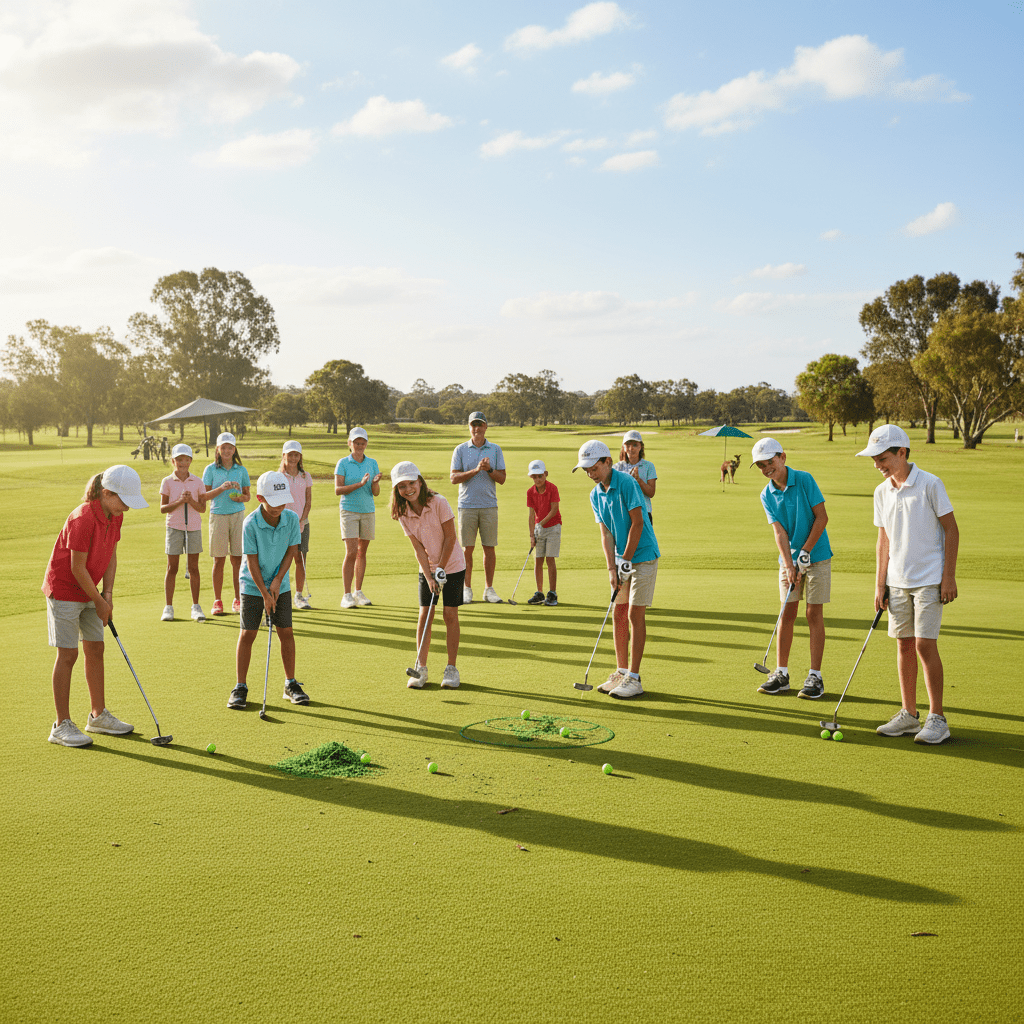
Getting Started with Junior Golf
Is my child too young (or too old) to start golf?
Children can start golf as young as 4 years old, though the approach varies by age. For 4-6 year olds, focus on fun introduction through modified games rather than formal instruction. Ages 7-10 are ideal for beginning structured lessons as coordination and attention span develop. Ages 11-14 can progress rapidly with proper coaching. Even teenagers 15-18 who are complete beginners can absolutely learn golf – many successful golfers started in their teens.
The key is readiness, not age. If your child can follow simple instructions, has basic hand-eye coordination, and shows interest, they’re ready to try golf.
Does my child need to be athletic or coordinated to play golf?
Not at all. Golf is one of the most accessible sports because it’s self-paced and non-contact. Unlike team sports requiring speed or strength, golf rewards patience, focus, and technique – skills that develop with practice. Many children who don’t excel at traditional sports thrive in golf because it allows individual progression without pressure to keep up with teammates.
Golf actually helps children develop coordination, balance, and body awareness. Your child will become more athletic through playing golf, not the other way around.
How do I know if my child will actually enjoy golf?
The best way is a low-pressure trial. Many Australian golf clubs offer “Come and Try” days or short-term junior programs (4-6 weeks) specifically designed for beginners. These programs use fun games and activities rather than repetitive drills.
Signs your child might enjoy golf:
- They like outdoor activities
- They enjoy individual challenges or puzzles
- They have patience for learning new skills
- They’re interested after watching golf on TV or seeing you play
If your child doesn’t enjoy it immediately, that’s okay. Some children need time to develop appreciation for golf’s unique rewards.
What’s the first step to getting my child into golf?
Start with a beginner-friendly junior program at your local golf club or driving range. In Australia, look for programs affiliated with Golf Australia or PGA of Australia, as these follow structured junior development frameworks.
Your first-step checklist:
- Search “junior golf programs” + your suburb/city name
- Call 2-3 local clubs to ask about beginner programs
- Attend a trial session or “Come and Try” day
- Start with borrowed or minimal equipment (many programs provide clubs)
- Commit to 4-6 weeks before deciding if golf is right for your child
Don’t invest heavily in equipment until your child has tried golf and shown sustained interest.
Equipment Essentials
Do I need to buy a full set of clubs right away?
No. Beginners only need 3-5 clubs to start: a driver or 3-wood, a 7-iron or 8-iron, a pitching wedge, and a putter. Many junior programs provide clubs for the first few sessions, and some clubs have loaner sets available.
Starter set recommendation:
- Ages 4-6: 3 clubs (iron, wedge, putter)
- Ages 7-10: 5 clubs (wood, 2 irons, wedge, putter)
- Ages 11+: 7-9 clubs (can progress to half-set or full set)
Starting with fewer clubs helps children learn proper club selection and isn’t overwhelming. As skills develop and interest solidifies, you can expand their set.
How do I know what size clubs my child needs?
Junior clubs are sized by height, not age. Using incorrectly sized clubs makes learning difficult and can create bad habits.
General sizing guide:
- Under 95cm tall: Toddler/preschool clubs
- 95-115cm: Small junior (ages 4-6 typically)
- 115-135cm: Medium junior (ages 7-9 typically)
- 135-155cm: Large junior (ages 10-12 typically)
- 155cm+: Extra-large junior or ladies’ clubs (ages 13+)
Most golf shops offer fitting services. Bring your child in, and staff can recommend appropriate sizing. Clubs should allow your child to maintain good posture without excessive bending or reaching.
Growth consideration: Junior clubs are typically used for 2-3 years before sizing up, so factor this into your budget planning.
What’s a reasonable budget for starter equipment?
For complete beginners testing their interest, budget $150-$300 for a basic starter set, bag, and balls. This gets quality equipment without over-investing before commitment is clear.
Budget breakdown:
- Starter club set: $100-$200
- Junior golf bag: $30-$60
- Golf balls (dozen): $15-$25
- Tees and basic accessories: $10-$15
If your child continues past the first 6 months and shows genuine interest, budget $300-$600 for a quality junior set that will last 2-3 years.
Money-saving tips:
- Check second-hand options at golf shops or online marketplaces
- Some clubs run equipment swap days for junior golfers
- Buy end-of-season sales (March-April in Australia)
Can my child use my old clubs cut down?
Generally not recommended. Simply cutting down adult clubs doesn’t account for weight distribution, shaft flex, or grip size – all crucial for junior development. Adult clubs, even shortened, are too heavy and improperly balanced for children.
Exception: If your teenager (15+) is tall (165cm+) and you have ladies’ clubs or lighter men’s clubs, these might work temporarily with professional shortening and re-gripping. Consult a club fitter first.
Properly designed junior clubs are engineered for lighter swing speeds and developing bodies. The investment in correct equipment pays off in faster skill development and better habits.
Finding Programs and Courses
How do I find junior golf programs near me?
Australia has excellent junior golf infrastructure across all states. Start with these resources:
National resources:
- Golf Australia website: Search their “Get Into Golf” junior program directory
- PGA of Australia: Find PGA professionals offering junior coaching
- MyGolf program: Golf Australia’s national junior program for ages 5-15
State-based searches:
- Search “[your suburb] golf club junior programs”
- Contact your local council – many operate public courses with junior programs
- Check driving ranges – many offer junior clinics at lower cost than club memberships
What to ask when calling:
- Age groups and skill levels accepted
- Program duration and schedule
- Cost and what’s included
- Whether equipment is provided for beginners
- Coach qualifications (PGA certified is ideal)
What’s the difference between group lessons and private coaching?
Group lessons (typically 4-8 children):
- More affordable ($15-$30 per session)
- Social learning environment – children make friends
- Structured curriculum covering fundamentals
- Best for beginners and recreational players
- Usually 45-60 minutes weekly
Private coaching (one-on-one):
- More expensive ($50-$100+ per session)
- Personalized attention and faster correction
- Flexible focus on specific skills
- Best for committed players or specific problem-solving
- Usually 30-45 minutes
My recommendation: Start with group lessons. The social aspect keeps children engaged, costs are manageable, and beginners benefit from structured fundamentals. Move to private coaching if your child shows competitive interest or needs targeted improvement.
Many families do a combination: weekly group lessons plus monthly private sessions for personalized feedback.
Do we need to join a golf club?
Not initially. Many clubs offer junior programs without requiring membership. Public courses, driving ranges, and council-run facilities provide access without membership fees.
When to consider membership:
- Your child plays regularly (weekly or more)
- They want to establish a home course and handicap
- They’re interested in junior club competitions
- The club has strong junior programs and social activities
Junior membership benefits in Australia:
- Significantly cheaper than adult memberships ($100-$500 annually depending on club)
- Access to junior competitions and club championships
- Practice facility access
- Pathway to competitive golf
- Social community
Calculate the break-even: If pay-per-play costs exceed membership fees, and your child plays regularly, membership makes financial sense.
Are there programs specifically for beginners?
Yes, absolutely. Look for these beginner-friendly programs across Australia:
MyGolf (Golf Australia’s flagship program):
- Specifically designed for complete beginners ages 5-15
- Fun, game-based learning approach
- Equipment often provided
- Low-pressure environment
- Runs in school terms at clubs nationwide
Come and Try days:
- Free or low-cost introduction sessions
- Held regularly at most clubs
- No commitment required
- Great for testing interest
School holiday clinics:
- Short-term programs (3-5 days)
- Mixed skill levels with beginner groups
- Affordable way to try golf intensively
When researching programs, specifically ask: “Do you have programs for children who have never played golf before?” This ensures you’re not placing your child in a group with experienced juniors.
Skill Development
How often should my child practice?
For beginners, quality matters more than quantity. Aim for:
Minimum for progress: Once weekly (lesson or practice) Ideal for steady improvement: Twice weekly (one lesson + one practice) For competitive development: 3-4 times weekly (lessons + practice + playing)
Important: Short, focused sessions (30-45 minutes) are more effective than long, unfocused ones, especially for younger children. Golf requires concentration, and children’s attention spans vary by age.
Practice structure recommendation:
- Ages 4-7: 20-30 minutes, focus on fun and basic movements
- Ages 8-11: 30-45 minutes, mix of skills and games
- Ages 12-15: 45-60 minutes, structured practice with goals
- Ages 16-18: 60-90 minutes, deliberate practice on specific skills
Consistency beats intensity. Regular weekly practice develops better habits than sporadic long sessions.
Can my child improve without expensive coaching?
Yes, though coaching accelerates progress and prevents bad habits. If budget is limited, here’s how to maximize improvement:
Free and low-cost development strategies:
- YouTube tutorials from reputable sources (PGA professionals)
- Practice at driving ranges (cheaper than course play)
- Putting practice at home (carpet or putting mat)
- Attend group clinics instead of private lessons
- Play public courses during off-peak times (cheaper rates)
- Use training aids for home practice
Invest strategically: Even occasional coaching (monthly or quarterly) helps ensure technique stays on track. Consider intensive coaching during school holidays, then practice independently between sessions.
Parent involvement: If you play golf, practice with your child. If you don’t, learn alongside them – many parents find this bonding experience valuable.
What should my child practice at home?
Home practice is highly effective for certain skills:
Putting practice (most valuable home practice):
- Set up targets at various distances
- Practice straight putts along a line
- Work on distance control
- Minimal space needed (hallway or carpet)
Chipping practice (if you have yard space):
- Chip into a bucket or hula hoop
- Practice different trajectories
- Develops feel and touch
Swing fundamentals (with practice aids):
- Grip practice (can do anywhere)
- Alignment stick drills
- Swing plane trainers
- Mirror work for posture check
Physical fitness:
- Flexibility exercises
- Core strength
- Balance activities
Mental game:
- Visualization exercises
- Goal setting
- Watching professional golf
What NOT to practice at home: Full swings without supervision can reinforce bad habits. Save full swing work for lessons or range practice where space is adequate and feedback available.
How long does it take to see improvement?
This varies significantly by age, practice frequency, and natural aptitude, but here are realistic timelines:
Beginners (first 3-6 months):
- Learning to make consistent contact with the ball
- Understanding basic rules and etiquette
- Completing 9 holes (even with high scores)
Developing players (6-12 months):
- More consistent ball striking
- Understanding club selection
- Scoring around 60-70 for 9 holes
- Comfortable playing with others
Intermediate players (1-2 years):
- Reliable contact with most clubs
- Strategic course management
- Scoring around 45-55 for 9 holes
- Ready for beginner competitions
Important mindset: Golf is a lifetime sport with continuous improvement. Celebrate small victories – better contact, lower scores, new skills mastered. Avoid comparing your child to others, as development rates vary widely.
Progress isn’t always linear. Plateaus are normal and often precede breakthroughs.
Competitive Pathways
When should my child start playing in tournaments?
There’s no rush. Introduce competition when your child:
- Can complete 9 holes independently
- Understands basic rules and etiquette
- Shows interest in testing their skills
- Can handle disappointment maturely
Typical timeline:
- Ages 7-9: Very casual club competitions or fun tournaments
- Ages 10-12: Local club championships and beginner tournaments
- Ages 13-15: Regional competitions if interested
- Ages 16-18: State-level events for committed competitive players
Starting points for competition:
- Club junior championships (low-pressure, familiar environment)
- Junior Golf Australia affiliated events
- State golf association junior events
- MyGolf competitions (modified formats for beginners)
Critical: Competition should enhance enjoyment, not create pressure. If your child resists competition, recreational golf is perfectly valid and rewarding.
Are there golf scholarships in Australia?
Yes, though they’re more common in the United States. Australian opportunities include:
Australian pathways:
- State institute/academy programs (talent identification)
- Golf Australia national squad programs
- Some private schools offer golf scholarships
- University sports scholarships (limited but available)
U.S. college scholarships:
- Hundreds of Australian juniors receive U.S. college golf scholarships annually
- Full and partial scholarships available
- Requires strong academic record plus competitive golf resume
- Recruiting typically begins age 15-16
Scholarship requirements:
- Competitive tournament results
- Low handicap (typically single digits)
- Academic eligibility
- Strong character references
If scholarships interest your family, focus on competitive development from ages 12-14 onward, maintain strong academics, and research U.S. college golf recruiting processes around age 15.
What are the pathways to competitive golf in Australia?
Australia has well-structured development pathways:
Recreational to competitive progression:
- Club level: Junior club championships and monthly medals
- District level: Multi-club events in your region
- State level: State golf association events and championships
- National level: Golf Australia national junior championships
- International level: Junior world championships and international amateur events
Development programs:
- State golf association junior squads
- Regional academies and high-performance centers
- Golf Australia national talent pathway
- Private coaching academies
Competitive categories:
- Handicap-based events (players compete within skill brackets)
- Age-based championships
- Scratch competitions (low handicap players)
- Team events (state teams, school teams)
Handicap system: Establishing an official handicap through club membership opens doors to competitive golf. This typically happens around ages 10-12 for committed players.
Does my child need to play competitively to enjoy golf?
Absolutely not. Golf offers lifelong enjoyment without competition. Many juniors play purely for:
- Social connection and friendships
- Outdoor activity and exercise
- Personal challenge and improvement
- Family bonding time
- Stress relief and mental health benefits
Recreational golf is completely valid. In fact, most adult golfers play recreationally, and many find golf’s non-competitive aspects most rewarding.
Benefits of recreational junior golf:
- Less pressure and stress
- More flexibility in practice and play
- Focus on fun rather than results
- Develops lifelong healthy hobby
- Can always pursue competition later if interest develops
Some children thrive on competition; others prefer casual play. Both paths are equally valuable, and your child’s preference may change over time. Let their interest guide the direction rather than external pressure.
Conclusion
Starting your child in junior golf is an exciting journey that can provide lifelong benefits, whether they pursue competitive pathways or simply enjoy recreational play. The key is starting with low pressure, appropriate equipment, and quality instruction while letting your child’s interest and enjoyment guide the pace.
Remember, every champion golfer started as a beginner, and every recreational golfer gains value from the sport. Focus on building positive experiences, celebrating progress, and fostering a love for the game.
For more detailed information about equipment, local programs, and junior golf tips, explore the other resources available on Junior Golf Australia.
 Junior Golf Australia